Why African teams are aiming high at FIBA U19 Basketball World Cup
SHEFFIELD (Julio Chitunda's African Message) - For the first time, the FIBA U19 Basketball World Cup will take place in Africa, and the continent's representatives couldn't be more confident
SHEFFIELD (Julio Chitunda's African Message) - For the first time, the FIBA U19 Basketball World Cup will take place in Africa and the continent's representatives - Angola, Egypt and Mali - couldn't be more confident in writing a new chapter in the history of the event.
In just under a month's time (July 1-9), the attention will be on the Egyptian city of Cairo where 16 national teams from all corners of the globe will fight for the right to be crowned U19 champions.
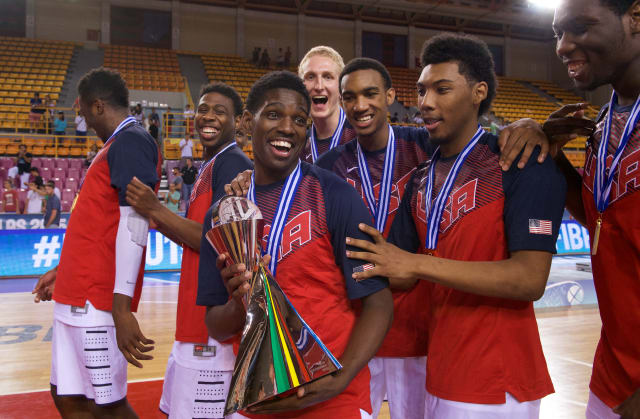
The USA, seen here in 2015, have won two of the last three editions of the FIBA U19 Basketball World Cup
In today's column, I will try to explain why African teams are aiming high at FIBA U19 Basketball World Cup.
Ever since the inception of the competition's current concept in 2007, Angola, Cote d'Ivoire, Mali, Nigeria, Senegal and Tunisia have carried the African flag in the tournament, but none has ever done any better than Egypt's 11th-place finishes in 2009 and 2015.
Now more than ever before, things look optimistic for the three African nations. Starting with the fact that Egypt will have a home crowd behind them and add to it the international experience that those three teams have gained over the past few years.
Unlike in past years, a number of African players who will feature in Cairo next month are now part of some reputable basketball programmes in the United States.
The Angolans, for instance, have recently named seven players in their preliminary squad, who currently play high school basketball stateside.
Egypt's 18-year-old Ahmed Khalaf last month made his debut in Spain's ACB League - arguably one of the most competitive top flights in the world behind the NBA - scoring two points in 7:31 minutes. The U19 hosts will certainly pray for the 6ft 9in (2.08m) center to keep his momentum in Cairo.
Ahmed Khalaf, renovado por 5 temporadas más con el Bàsquet Manresa https://t.co/aoLCWCnCXU pic.twitter.com/azUidw7uaR
— PIRATASDELBASKET (@PIRATASBASKET) May 14, 2017
Egypt, who finished second at the FIBA Africa U18 Championship last summer in Rwanda, have been drawn in Group B, which includes Germany, Lithuania and Puerto Rico.
"The most important thing we have right now is we want to play a great tournament in Egypt with the support of all the country," said the team's head coach, Juan Orenga.

Angola head to Cairo as the reigning U18 African champions
When I recently talked to Angola's Bruno Fernandes, who played a major role in Angola's U18 continental title run in 2016, he explained why this year's FIBA U19 World Cup matters for Angola, Egypt and Mali.
"Even though these three countries have different cultural backgrounds, we are in the tournament for one common goal, which is to take African basketball to the next level," he said.
Appearing at their first FIBA U19 Basketball World Cup since 2009, Angola will face off against the United States, Iran and Italy in Group D.
"When we faced the US in Dubai (at the FIBA U17 Basketball World Cup in 2014) our team was mostly based in Angola. We didn't have any experience of American basketball. I had a good game, but I look forward to playing even better when we meet again in Cairo," Fernandes noted.
Mali qualified for the U19 World Cup by coming in third at last year's U18 continental event and the team's head coach Kaba Kante has high expectations for his team in Egypt.
He said: "Mali will head to Cairo not with the ambition of winning the title but with the determination of making a great impact. Ten years later we are back at the world stage and we have to show that Malian basketball has made a great progress."
Let the Cairo battle begin.
Julio Chitunda
FIBA
FIBA's columnists write on a wide range of topics relating to basketball that are of interest to them. The opinions they express are their own and in no way reflect those of FIBA.
FIBA takes no responsibility and gives no guarantees, warranties or representations, implied or otherwise, for the content or accuracy of the content and opinion expressed in the above article.